
Check whether you have a comparison yet
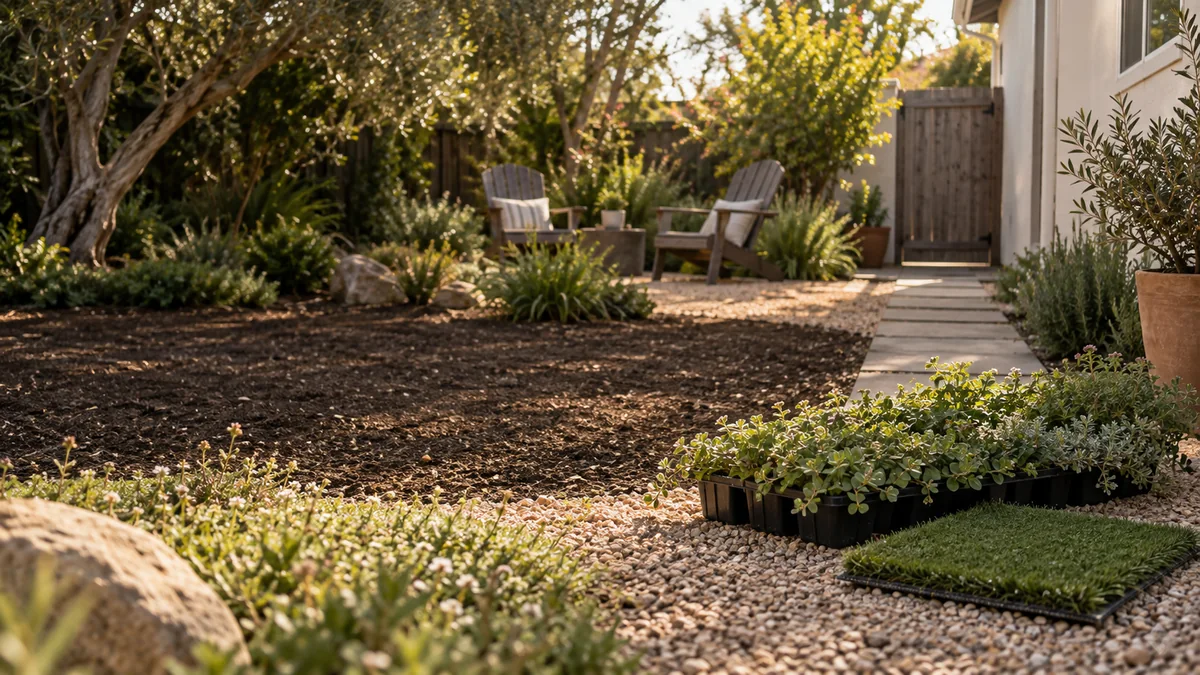
A low green planting can fill a photograph and still be the wrong thing to compare with a walking surface. “Living groundcover” names many plants; “artificial turf” names many manufactured products. Neither phrase tells you whether that part of the yard is meant to be looked at, crossed every morning or used when chairs come out on the weekend.
Before listing pros and cons, ask: Are both options being considered for the same place and the same daily job? Can you identify each proposed plant or synthetic product well enough to find its care information? If the place, use or option is different, the side-by-side comparison is premature.
California’s Department of Water Resources suggests marking intended uses on a yard diagram before replacing a lawn. That is a better starting point than declaring a winner for the entire yard.
Not comparable yet
Living groundcover for the front view versus synthetic turf for a back play patch. Different places and uses make the material comparison misleading.
A comparable question
For the daily route to the side gate, which named living option and which named synthetic option—if either—are proposed for that same use?
If one option has no answer for the stated job, keep it as an open question. A similar green appearance does not make two choices functionally equivalent.
Source notes: B07-DWR-LAWN
One small yard, three different jobs
Imagine a compact yard with a narrow strip visible from the living room, a route to the side gate, and an open patch where movable chairs sometimes go. This is a fictional example, not a HOMEFRONT property, design or recommendation. The areas may look like one green rectangle in an inspiration image. They are not the same decision.
The strip is mostly seen and rarely stepped on. Here the household can compare how a named living plant and a named synthetic product would look and be cared for. A claim about heavy foot traffic would answer a question nobody asked about this strip.
The gate route is crossed daily. A living option described only as “low-growing” has not answered whether it is meant to take those footsteps. The household needs that answer for the actual selection. If it is not meant as a walking surface, a separate path may be worth discussing instead of hoping the planting will do a second job. A synthetic sample also needs a product identity and use-and-care information; its green appearance is not the answer.
On the open patch, chairs move and people spend time outdoors. The household describes how often, then asks what each named option can support. Neither a plant photograph nor a small turf sample establishes how the full area will work. A non-green surface can stay on the list if the real job calls for one.
This exercise may rule out the tidy “one green material everywhere” idea before it rules either material in. It does not prescribe three zones for every yard.
Source notes: B07-DWR-LAWN
Compare named options, not promises
“Low maintenance” and “green all year” sound convenient, but neither identifies a planting or a synthetic product. For a living option, ask for the plant name, proposed location, assumed site conditions and applicable care information. For a synthetic option, ask for the product identity and its own care instructions. Keep the appearance sample tied to that identity; a similar color is not confirmation of the same finished system.
UC Orange County Master Gardeners show multiple living alternatives grown at an Irvine research and extension center. That illustrates why “groundcover” is not one plant with one appearance or care pattern. The list does not establish which plant belongs at your address.
Source notes: B07-UCORANGE-TURF
Maintenance belongs in the comparison
Living selections have plant-specific care and water needs. A manufactured surface avoids mowing but can still call for cleaning and debris attention. UC Master Gardeners’ artificial-turf guidance discusses those tasks; it is not a schedule for your product or yard.
Write down what routine the household is willing to take on, then ask which actual care guidance applies to each named option. A broad “easy care” label is too thin to compare.
If you see confident cost, savings, lifespan or rebate numbers, ask what actual product, area, water account and program they describe. This guide supplies none of those estimates.
Source notes: B07-UCALAMEDA-TURF, B07-UCORANGE-WATER
Leave with a more useful brief
In the example yard, the household may keep exploring a planted strip, investigate a true route to the gate and leave the chair area open until the surface choice is clearer. No species, synthetic system or construction scope has been selected.
Make a private sketch of your own yard. Label what you mostly see, what you cross and where you spend time. Mark any overlap. Write actual option names beside each area and leave unknowns blank. The comparison begins only where two described options are being considered for the same place and job.
Once a proposal exists, the landscape-proposal guide helps connect selections, drawing areas and care handoff. For a path or sitting surface, the hardscape-proposal guide handles the adjoining written scope. A site-specific decision belongs with the responsible provider.
Source notes: B07-DWR-LAWN