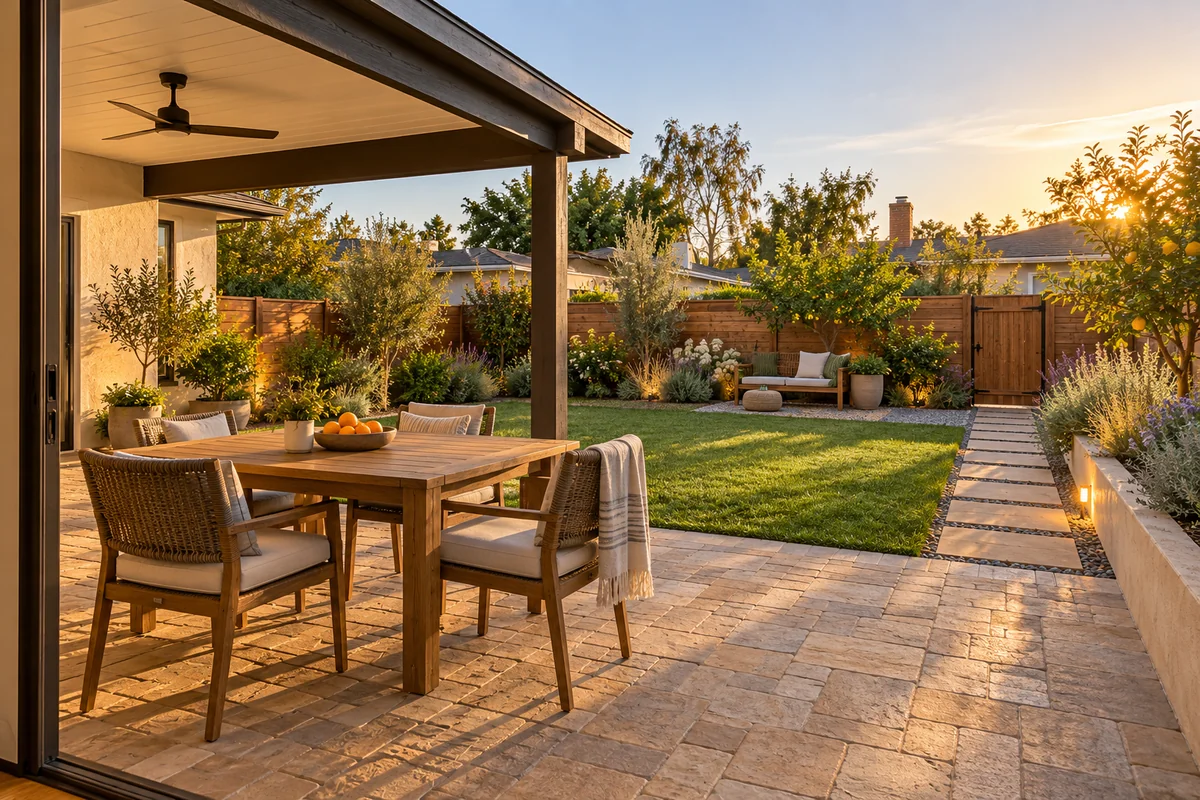

Begin with how you want to use the yard
A landscape conversion proposal is easier to discuss when a drawing and plant list connect to a household goal. Write down what you want to keep doing outside and what you want to change: a place to sit, a planting area to enjoy from a window, or a clearer arrangement of planted and unplanted spaces.
Then check how the proposal represents those intentions. This is a homeowner document checklist, not a complete landscape specification, a plant recommendation or a review of site design. It helps you identify the questions that a picture of the finished yard cannot answer.
Separate retained areas from proposed changes
Give each area a stable name, such as front planting bed or space beside the patio. Match that name to the drawing, plant list and written work description. Mark existing plants or features that are intended to remain, items described for removal, proposed additions and anything still undecided.
Use the same labels when you request a revision. If an area appears in the rendering but not the written scope, ask whether it is included, illustrative or a later option. Do not treat every object in an inspiration image as a promised deliverable.
Build a planting-area record
| Record | What to ask for | Why it belongs in the conversation |
|---|---|---|
| Area and drawing reference | Named location and current drawing/version | Connects the plant list to a specific part of the yard. |
| Plant identity | Proposed botanical name, common name and named variety when specified | Keeps a broad description such as flowering shrubs from standing in for the actual selection. |
| Supply description | Listed quantity and container size, if specified | Shows what the written proposal says will be supplied; it is not a prediction of mature size. |
| Expected mature dimensions | Source and stated mature height/width for the proposed selection | Makes the future-size assumption available for discussion without treating it as a guaranteed result. |
| Selection status | Proposed, confirmed, substituted or unresolved | Keeps an earlier plant list from being mistaken for the current version. |
Keep identification separate from suitability
UC Marin Master Gardeners recommends using botanical names to avoid confusion when making a nursery list and reading plant tags for mature-size information. Those are useful record habits. Its Marin plant lists are not a recommendation for a particular Southern California property.
Ask the proposal author to identify the actual selections and the information used to describe them. Keep the source with the list. A name, tag or finished-yard image does not settle whether a plant fits your specific site, intended use or care arrangements. Leave unresolved suitability questions visible for the person responsible for the design.
Source notes: AP3D-UCANR-PLANT-RECORD
A hypothetical revision: the plant list changes
A household’s first drawing labels a bed with a specific plant selection. A later email proposes a substitute, while the written plant list still shows the earlier name. The household does not know which version the current proposal describes.
They record the proposed replacement separately and ask for an updated name, quantity, supply description and corresponding drawing note. They also ask which care information will apply if the replacement is selected. This resolves the document mismatch; it does not establish that the plants are equivalent. The example is invented and does not describe a HOMEFRONT project.
Identify what will be handed over, and by whom
| Deliverable to discuss | Record to request | Unresolved question to keep visible |
|---|---|---|
| Final plant and area list | The selections actually supplied, tied to their locations | Who updates the list if a substitution is made? |
| Named materials | Product or material identification for the items in this scope | Does the final record match the selected version? |
| Care information | Instructions or source references for the actual selections | Who provides the information, and who explains an unclear instruction? |
| Included follow-up | Written description of any agreed return visit or handoff conversation | What is included, who handles it and how is it arranged? |
| Adjoining hardscape or irrigation records | Reference to the relevant scope and supplied system documents | Which person or document addresses questions outside the planting scope? |
Ask how the care responsibility changes after handoff
Describe the care involvement your household wants and can realistically discuss: doing routine tasks yourself, arranging help or combining the two. Ask the proposal author what information you will receive for the actual selections and whether any follow-up is included. Avoid using “low maintenance” as a substitute for a named set of responsibilities.
Record who will answer care questions, where the instructions will be kept and which items are still unresolved. Do not invent a watering schedule from a general label or copy one from a different yard. This guide does not prescribe irrigation settings, plant treatments or an establishment program. It organizes the handoff questions for the appropriate provider.
Reconcile the drawing, list and written scope
Before treating two proposals as comparable, check that each describes the same named areas and household intentions. Follow one area from the drawing to its plant list and then to the promised records. Repeat for retained features and separate options. A missing description is a question, not proof that the item is unnecessary.
Keep a compact follow-up list: the area, the conflicting or missing description, the person asked and the response or revised document. Store household drawings and personal details privately. For the surface work beside planting areas, the hardscape proposal guide provides a separate area-to-scope crosswalk. These linked records can make the next conversation more specific without claiming a design, permit, rebate or construction outcome.