
The window isn't just an opening
Imagine finding an old family photograph that shows three matching front windows. Today's house has two originals and a third that was replaced years ago. Before ordering a product for the remaining openings, the owner has a useful question: which dimensions, divisions and trim details give the facade its character?
The National Park Service's 1981 Preservation Brief 9, The Repair of Historic Wooden Windows, explains how to evaluate and repair historic wooden windows. Its hands-on methods predate EPA's 2008 lead-safe renovation rule, so do not treat them as instructions for disturbing old paint or putty. California's Office of Historic Preservation collects studies on repairing and retrofitting original windows as an alternative to replacement.
Source notes: TB-NPS-WINDOW-BRIEF9, TB-CA-HIST-OHP
One very important detail in homes built before 1978
Painted sash, older glazing putty and trim in pre-1978 homes can contain lead-based paint, which can create a hazard when work disturbs it. For paid covered work, EPA's Renovation, Repair and Painting (RRP) rule treats replacing a window of any size as renovation; replacement is not eligible for the rule's minor-repair exception. A certified firm should establish the rule's application to the specific home and proposed work.
Do not scrape or loosen paint or putty to make an evidence card. Ask whether an EPA Lead-Safe Certified firm and Renovate Right notice are required for the proposed paid work. CDPH has a statewide index of California-certified lead-related construction professionals; the scope of those credentials is separate from an EPA renovation-firm certification.
Replacing a pane, sash or balance can be distinct from replacing the entire window under EPA guidance, but removing older painted glazing still disturbs a coated surface. A window repair may be covered unless it meets the appropriate minor-repair requirements; qualified personnel should make that determination.
Source notes: TB-EPA-LEAD-RRP, TB-CA-CDPH-LEAD
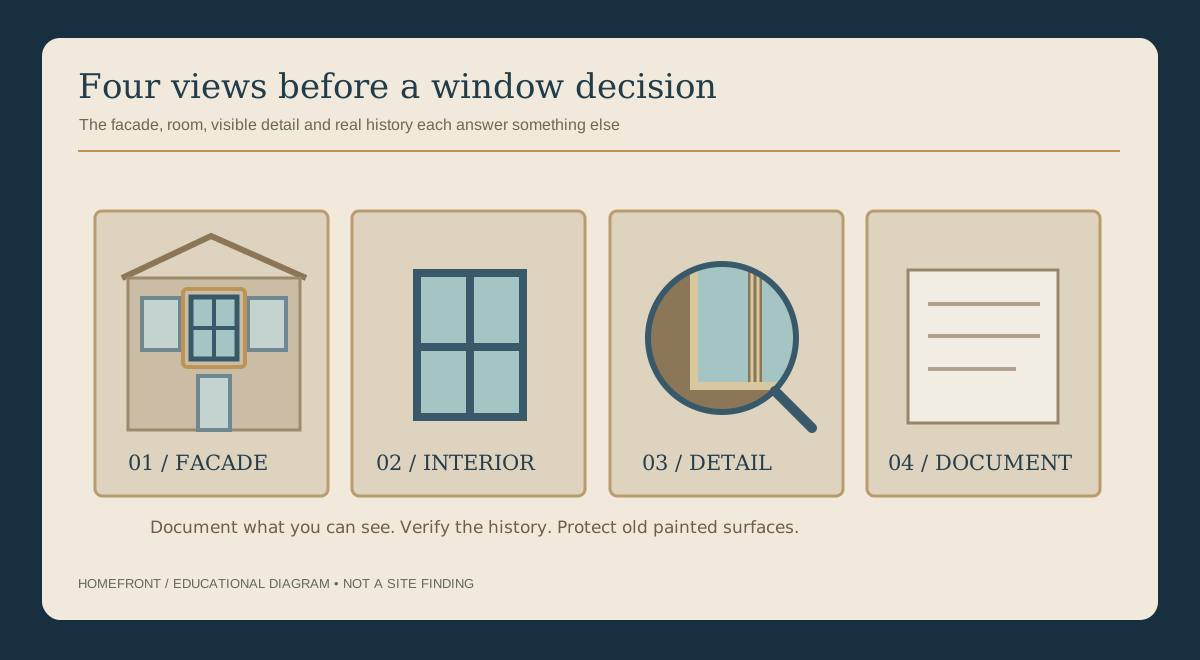
Your four-view window evidence card
| View to keep | What the record actually shows | What it does not settle |
|---|---|---|
| Facade from normal ground-level access | The rhythm, size, visible frame shape and relationship to other openings | Whether the house has a formal designation or a compliant design |
| Interior context | How the opening serves the room, light, use and available operation | The cause of drafts, noise or condensation |
| Close detail from safe access | A visible sash, trim or finish condition and where it appears | Concealed rot, paint composition or technical suitability |
| Document and date | Old photographs, product labels, work orders or earlier plans actually available | Whether a previous alteration was approved or performed correctly |
Questions to ask before the decision becomes irreversible
Which parts are original or documented alterations?
Ask what supports that conclusion and what remains unknown.
Which problem has been observed versus assumed?
Separate visible deterioration from guesses about hidden moisture or frame conditions.
Is there a preservation authority to consult?
The relevant local city and the actual resource designation matter, not simply a neighborhood name.
What lead-safe precautions and credentials apply?
Obtain guidance through EPA and qualified personnel for the actual age, occupancy and proposed disturbance.
What is the evidence for the proposed treatment?
Ask why repair, selective changes or full replacement were considered; this guide doesn't choose a winner.
Make a preservation decision file before comparing a proposal
Write the desired outcome
Is the homeowner trying to improve operation, preserve a facade feature, reduce a recurring discomfort, or simply refresh appearance?
Collect the safe four views
Photograph ordinary accessible conditions without climbing, removing components or scraping coatings.
Attach attributable history
Keep actual photos, plans, purchase records, repair notes and their dates. Mark guesses as unknown rather than fabricating provenance.
Check designation from the proper authority
A historic-looking house is not necessarily a designated resource; consult the actual city's or state's official records where a formal status question exists.
Compare a bounded professional recommendation
Ask what was examined, what is proposed, what remains concealed and which existing character-defining details the proposal affects.
Control private records
Keep photographs, family details, full addresses and ownership documents in private files; do not put them on a public worksheet or share them without a reason.
Keep the story visible while considering change
A window can be historically significant, recently altered, difficult to operate or simply a standard feature of an older home. A useful decision starts with honest evidence and current goals, not a blanket belief that 'new is best' or 'old must never change.'
A four-view card gives a preservation reviewer and a window specialist something concrete to discuss. It is a research aid, not authorization to replace or work on any particular property.