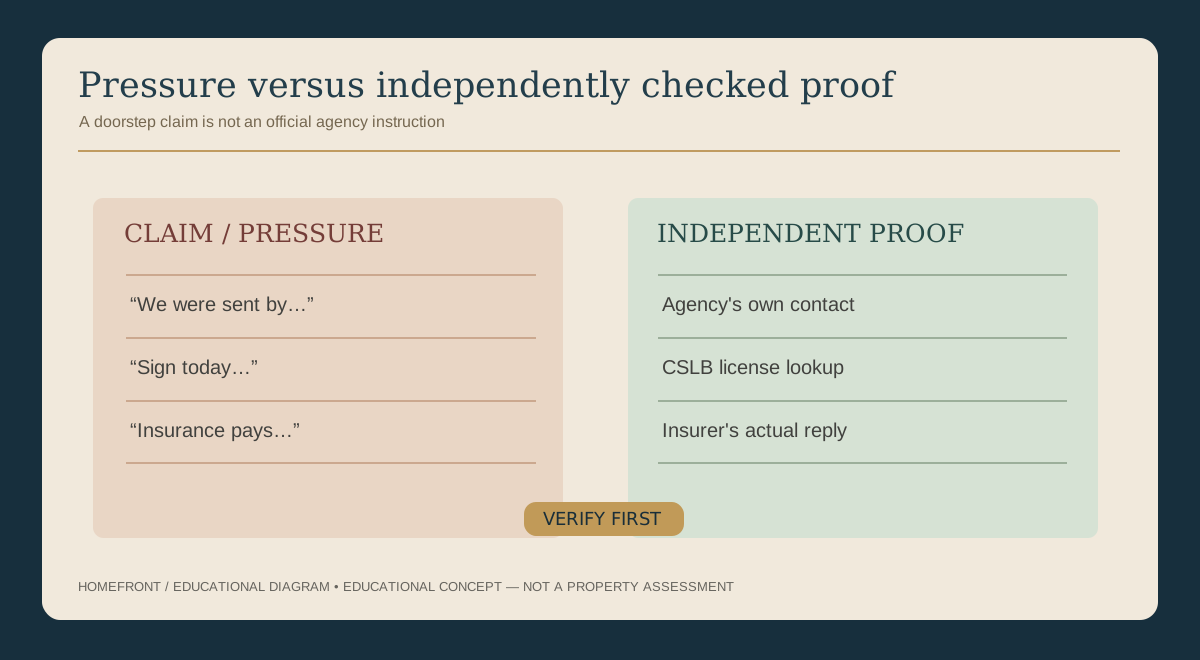

Two urgent things that should never be confused
One urgency is real: unsafe wiring, unstable structures, ongoing fire, flooding or threats to people. Those concerns belong with emergency authorities and qualified responders. The other urgency can be manufactured: a salesperson wants a signature before the homeowner has checked the company, the scope or the program it claims to represent.
The Federal Trade Commission warns that disaster recovery attracts people who claim official affiliations or ask for payment up front. California's Contractors State License Board runs a Disaster Help Center and a public license lookup. Look the agency up yourself rather than calling a number printed on a flyer.
Source notes: TB-FTC-DISASTER, TB-CSLB-DISASTER
A one-page doorstep evidence card
| The statement you hear | What you can ask to see | Who can actually answer |
|---|---|---|
| We were sent by the city or utility | The agency's own website or phone number, found independently, and whether it names this program or business | The named agency or utility |
| Insurance will pay for all of it | Your insurer's written claim instructions | Your insurer |
| We can begin today if you pay now | The business's license record and a complete written scope and price | CSLB for license status; you decide the timing |
| This signature is just a placeholder | The entire written agreement, including blanks, payment terms and any cancellation notice | A California attorney, if you want advice on the terms |
| A neighbor hired us, so you can trust us | The same independent license and business checks, not a referral alone | You, using official lookups |
| We do not need a contractor license for this work | CSLB's license lookup and CSLB's own guidance on when a license is required | CSLB |
| We can handle your insurance claim ourselves | A written explanation of who they are and how they would be paid, checked with your insurer and the Department of Insurance | Your insurer and the California Department of Insurance |
Source notes: TB-CSLB-DISASTER, TB-CA-INSURANCE-CONSUMER
Where each answer actually lives
Disaster rebuilding raises questions with different owners. Whether a business holds a license, and what CSLB's disaster guidance says about rebuilding contracts and payments, belongs with CSLB. Coverage, claim steps and anyone offering to represent you on a claim belong with your insurer and the California Department of Insurance. What a specific contract means for you is a question for a California attorney.
Concerns about prices after a declared emergency go to the California Attorney General, and suspected scams can be reported to the FTC. California's rules can change after a major disaster, so open each agency's current page rather than relying on a flyer, a salesperson or this guide.
Source notes: TB-CSLB-DISASTER, TB-CA-CSLB-DISASTER-FAST, TB-CA-INSURANCE-CONSUMER, TB-CA-AG-PRICE, TB-FTC-DISASTER
Seven useful questions before trusting a repair offer
Who sent you here?
Find the claimed agency through independently located contact details, not the seller's provided callback number.
What has someone qualified actually inspected?
Separate observed damage and work recommendations from assumed problems.
What is the licensed business name?
Use the public CSLB lookup for license status and appropriate classification.
What exactly is in the scope and agreement?
Ask about included work, exclusions, owner approvals, payments and change orders.
What rule makes this urgent?
If a deadline is claimed, identify the authority and obtain its actual written instruction.
What will remain on record?
Keep the dated proposal, seller's claims, insurer correspondence and the independent verification result in separate files.
Which agency can receive a report?
CSLB takes contractor complaints, the Attorney General takes price-gouging reports and the Department of Insurance takes insurance questions. Use their own websites, not a link from the seller, and don't send sensitive details to the salesperson.
The small verification packet
Keep government IDs, bank data, full insurance files, private photos and identity details outside any publicly shared copy.
Mark questions to bring to a conversation. This is not a safety score or inspection. Selections stay on this page and disappear when you leave.
A sound decision can stand a little daylight
A responsible recovery plan begins by treating danger appropriately and verifying a purchase independently. A clear written record protects memory when several people are calling, visiting and sending information at once.
This guide is general planning help built from public agency pages. It cannot evaluate an emergency, interpret a contract or a policy, or identify a scammer. For those answers go to the agency, your insurer or a California attorney, and reopen official pages before you rely on them.