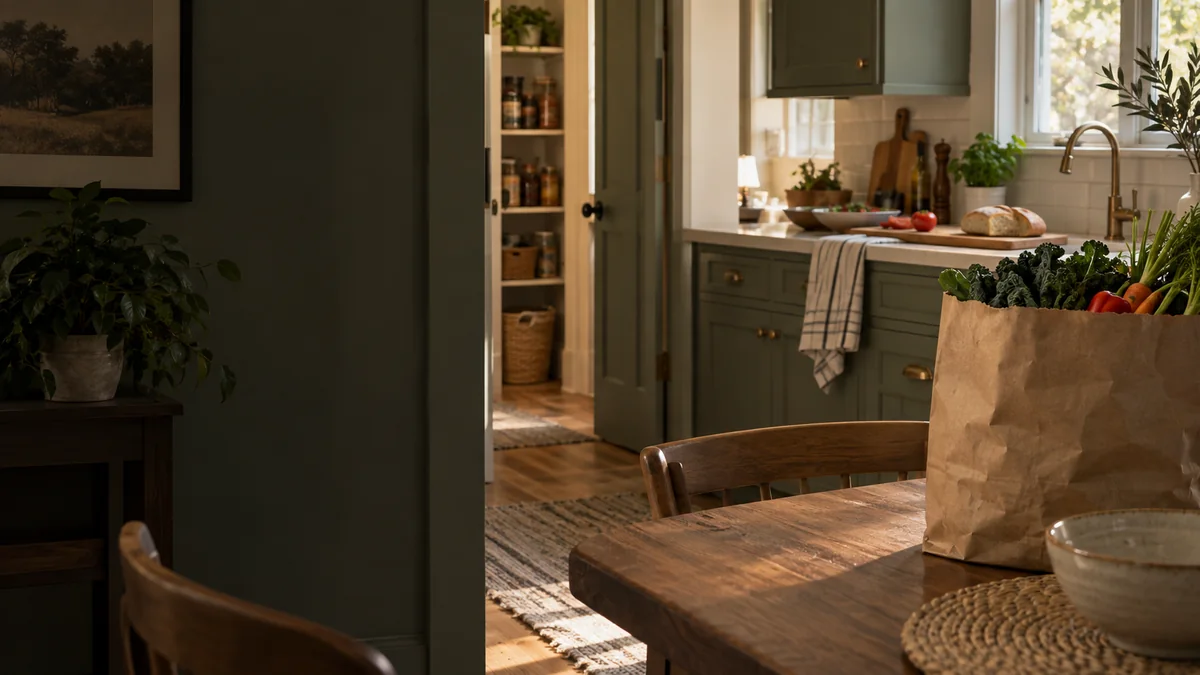

The grocery bag that takes a detour
In this fictional household, one grocery bag usually goes from the entry to a counter near the pantry. From there, pantry items and chilled food reach their familiar places. On a busy afternoon, lunch ingredients occupy the usual sorting spot. The bag waits on the dining table until the counter is free.
That small detour is an observation within the example. No room was measured, no HOMEFRONT project is shown, and the story does not prove that the kitchen needs more space or a new layout. The useful question is what happens during the task and what the household wants to retain.
Trace one bag, not the whole room
A task trace names where the routine starts, where it pauses and when it resumes. It lets the household describe an interruption without turning it into a design answer.
Arrive
The bag comes through the entry. The household usually sorts it on the counter near the pantry. That familiar place works when available.
Pause
Lunch preparation occupies the counter, so the bag waits on the dining table. Record the pause without calling it a circulation or storage failure.
Resume
When the counter is free, the items go to their usual places. Ask whether the detour recurs and which part of the familiar routine matters to keep.
The sequence does not tell us whether different timing, another sorting surface, altered storage or construction would be helpful in a real home. Those are separate questions for the actual household and, if physical work is considered, an appropriate professional who can assess the room.
Record the unknown before proposing a fix
For a few ordinary uses, note when the counter was occupied, where the bag waited, who was doing what, and whether the same interruption occurred again. Also record when the usual route worked well. A single busy afternoon is not a pattern.
A private note might read: “Grocery put-away is easy when the counter near our pantry is available. When lunch preparation uses it, one bag waits on the dining table. We want to keep easy pantry access. We do not yet know how often this overlap happens or which response would help.” The note is invented; it is neither a customer account nor a construction instruction.
Send the next question to the right guide
If the household later weighs a physical change, the kitchen layout guide compares the questions behind keeping or changing the arrangement. The cabinet guide is useful only if a specific storage concern remains. Neither guide can decide feasibility from this invented story.
When actual work is proposed, compare your priority with the written description of the work, materials and equipment. That limited documentation question is supported by the California Contractors State License Board homeowner checklist. Your household note is a starting point, not a construction scope or bid.
Keep the note privately for now. Online inquiries remain closed; nothing in this guide sends or stores your answers.
Source notes: AP2-CSLB